
Fresh Tarmac and Historic Tracks:
First Wheelchair on the Stoke Mandeville Relief Road.
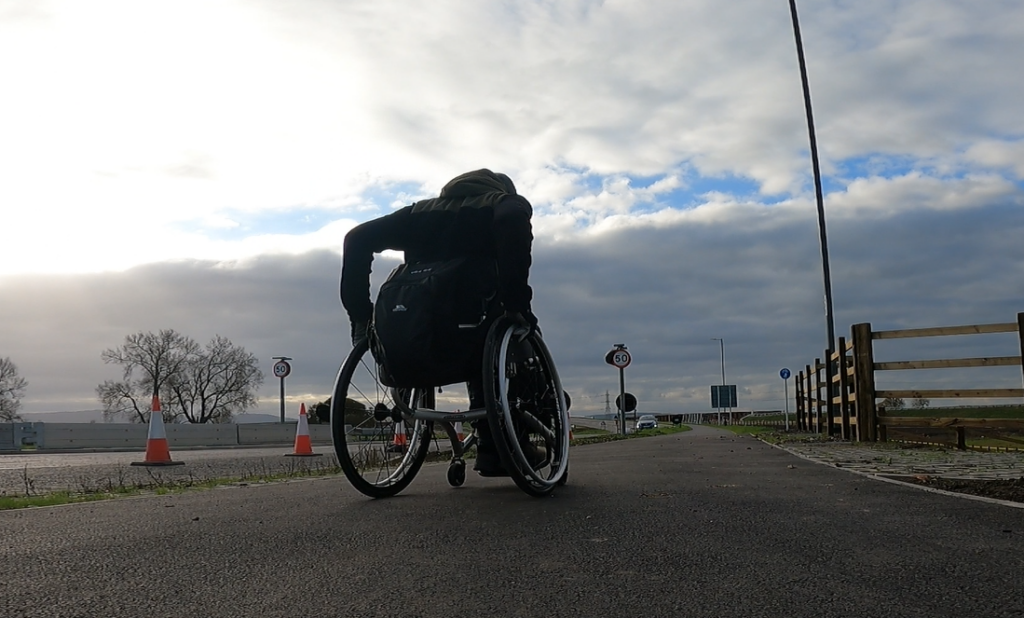
There is a very specific scent that signals progress in the infrastructure world: the acrid, warm smell of freshly laid tarmac. In this case on the new Stoke Mandeville Relief Road. For most people, a new relief road signifies shaved minutes off a commute or less congestion in the village centre. For me, looking at the newly opened Stoke Mandeville Relief Road, it looked like a blank canvas. It looked like a challenge to push my wheelchair along.
I decided to accept that challenge. I am incredibly proud to say I became the first manual wheelchair user to push the entire length of the new relief road’s path.
It wasn’t a race. There were no medals at the end. But rolling that route, in this specific town, where I first visited in June1993 after a RTC, felt like bridging history with the future.
The Allure of the New
If you are a wheelchair user, you know that terrain is everything. We spend our lives navigating cracked pavements, dropped kerbs that aren’t actually dropped, and gravel paths that feel like quicksand.
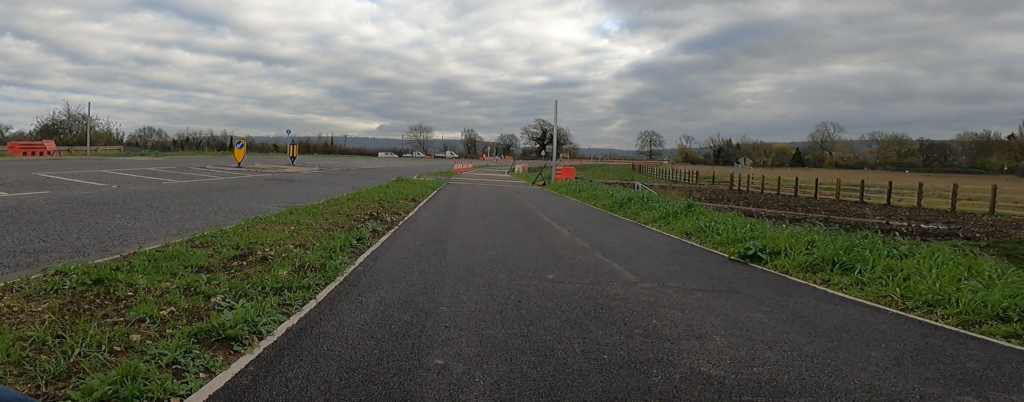
When I saw the smooth, pristine black ribbon of the path running alongside the new carriageway, it was irresistible. It was buttery smooth—a rare luxury that any roller, skater, or pusher appreciates. I wanted to be the first to put my tracks on it before the inevitable weathering of British seasons set in.
I parked up at one end, checked my tires, strapped on my gloves, and looked down the long stretch, knowing the end was distant.
The First to Push
The distance of the relief road isn’t marathon-length, but when you are not necessarily an athlete, supplying the horsepower entirely with your shoulders and arms, every incline makes itself known. Adjusting my pushing technique to work the different gradients certainly helps.
Covering the first kilometre as the first wheelchair on the Stoke Mandeville Relief Road, was pure joy. Furthermore, the glide on the new surface was exceptional. The resistance was low, and I got into a rhythmic cadence—push, roll and recover, push, roll and recover. The noise of the nearby traffic faded into a steady hum, replaced by the whoosh of my wheels.
About halfway through, the reality of the effort kicked in. The route is relatively flat to the eye, but my shoulders detected subtle gradients that a car engine wouldn’t even register. Especially when it raises up over the HS2 track. The burn started in my deltoids and crept down my triceps. It was that familiar, gruelling conversation between my mind wanting to keep the pace and my muscles asking for a break.
But I couldn’t stop. Not on the maiden voyage.
The Stoke Mandeville Connection
As I pushed, my mind wandered to where I was. It’s hard not to roll close to Stoke Mandeville without feeling the weight of its legacy.
This is the birthplace of the Paralympic movement. Just down the road is the National Spinal Injuries Centre, where Sir Ludwig Guttmann revolutionized care and proved that sport and movement were vital to rehabilitation. Importantly, he believed that life didn’t end with a spinal cord injury; it just changed gears.
Pushing along this brand-new piece of modern infrastructure, I felt a profound sense of connection to that history. The early pioneers of wheelchair sport in the 1940s and 50s were pushing heavy, cumbersome chairs on uneven hospital grounds. I was pushing a lightweight chair on state-of-the-art tarmac.
My effort was a small, modern echo of their immense determination. Every rotation of my wheels felt like a nod of respect to the giants upon whose shoulders we all now roll.
More Than Just Asphalt
Finishing the route, with aching arms, I realized this was about more than just “being first.”
A relief road’s primary job is to move cars. But the inclusion of a wide, smooth, accessible parallel path is a statement. It says that this space isn’t just for engines; it’s for people.
By pushing the length of it, I wanted to “christen” that path for our community. I wanted to show that this infrastructure will be used, and it is appreciated.
The Finish Line
When I reached the end of the relief road, with the Chiltern Hills in the distance, I stopped, turned my chair around, and looked back down the long stretch I had just covered.
I felt an immense sense of satisfaction.
I may have been the first wheelchair user to push this route, but I sincerely hope I won’t be the last. The tarmac is fresh, the route is smooth, and the history surrounding you is inspiring.
If you’re local and you roll, get out there and give it a push. The road is open.
To See the Open Road:
Check out my YouTube channel to see me roll the Relief Road.
Freedom Wheelchair Skills – Intro.
Stoke Mandeville Relief Road – short video of the first wheelchair.
The post First Wheelchair on the Stoke Mandeville Relief Road appeared first on Freedom Wheelchair Skills.